Italiano
 Deutsch
 Français
 Español

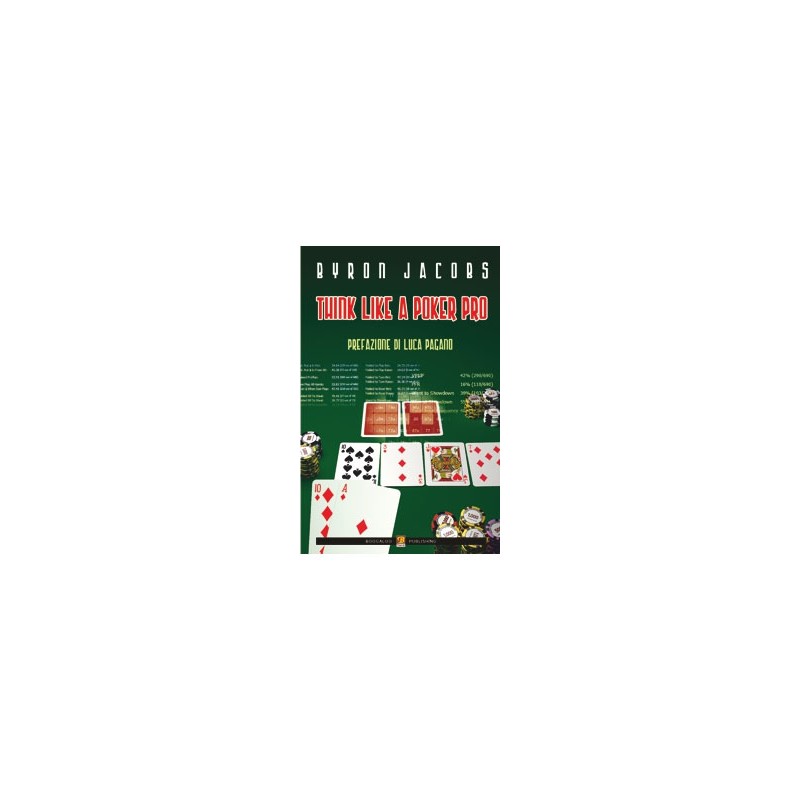
Poker theory has made enormous progress in recent years and it was clear that a new book should reflect this development.
Poker theory has made enormous progress in recent years and it was clear that a new book should reflect this development. Key elements such as hand ranges, pot equity and tournament equity are now much better understood and new tools for understanding the game have been developed such as the ICM (the independent chip model). This book examines the game by giving an idea of how strong a player thinks about the table. However, simply sitting down at the poker table and "playing well" is no longer enough to be successful. In addition to playing well, today it is essential to study effectively, prepare well and be ruthlessly honest in analyzing your game. Playing well must include these factors. The book will deal with these issues. It will identify how the winning players approach the analysis of their own game and that of their usual (and sometimes not very usual) opponents. There will be material on the use of statistics, on carrying out calculations, on analyzing your own game, on studying and planning. He will then explain how to find and make use of information. In short: it will be a war manual for the serious poker player. Reading this book won't instantly turn you into brilliant players. However, he will show you what good players do and how you can emulate their approach to poker. What I will do is go through a large number of different poker scenarios and explain how a strong player thinks about the table and then analyzes his game once he is away from the table. Much of the poker covered in this book is drawn from FL's cash tables because that is my specialty and the game that I have focused on for most of my poker career. However, there will also be numerous game examples drawn from other variations such as Omaha, No-Limit Hold'em and (notably) tournaments and sit 'n' go's. You will also notice that nearly all examples emerge in heads-up play situations or involve hands that will very soon become heads-up. This is entirely intended as the vast majority of poker hands today are played heads-up, while multiway pots, although not exactly unusual, are seen far fewer. Also, play in multiway pots tends to be more linear (either you have what you consider to be the best hand or you have adequate pot odds to chase a draw). Essential plays and techniques in heads-up matches, such as bluffing, semi-bluffing, floating, estimating and balancing ranges, inducing bluffing etc., have much less relevance in multiway pots as most of the time , in order to win, the latter require that the showdown be reached with the best hand and so they tend to be more linear. By adopting this approach, I intend to equip the reader with the tools to be able to improve his game rather than simplifying by identifying "correct" plays with the implication that if the reader can understand them and adopt them in his game he will improve naturally.
We also remind you that the Italian version will be embellished with a preface by Luca Pagano.

Specific References